

Rebrands don’t often fail, but the thinking does.
Most rebrands don’t fail because the design is bad. They fail because the brand never was never clear on what the problem is they are trying to solve.
Design just ends up taking the blame.
If you’ve ever invested good money into a rebrand only to feel let down by the result, this is probably why.
Rebrands are usually triggered by an ongoing feeling of discomfort
Sales have stalled, the brand feels tired, the category feels crowded or something just isn’t working anymore (sound familiar?)
Instead of diagnosing the real issue, brands jump straight to the visible part of the solution. New logo. New packaging. New look.
It feels productive. It feels decisive but it skips the most important step, understanding what is actually broken.
A rebrand shouldn’t be a reset button. It should be a response to a specific problem. When that problem is unclear, the outcome will be too.
Why design becomes the scapegoat
When a rebrand disappoints, the critique can be pretty vague.
“It doesn’t feel right.”
“I expected more.”
“I’m not sure it’s us.”
These aren’t design problems. They are clarity problems and if you follow me on the gram you know how I feel about clarity. Clarity sells!
Without a clear definition of success, design becomes subjective. Everyone has an opinion. Stakeholders pull in different directions. Feedback turns into a battle of taste rather than objective judgement.
The brand may look different, but it doesn’t feel better and because design is the most visible part of the process, it takes the hit.
The brief is where most rebrands often go wrong
Most brands think they have a brief when in reality what they have is actually just a list of preferences.
“Make it more modern.”
“Elevate the brand.”
“Feel more premium.”
“Stand out more.”
These are opinions, not objectives. They describe a vibe, not a problem to solve. Vibes don’t pay the bills folks.
A strong brief doesn’t tell a designer what to make (contrary to popular assumption)
It tells them what the brand needs to achieve. Commercially, strategically, and behaviourally. The end objective leads the solution, not the other way around.
If the brief is vague, the outcome will be too. No amount of creative talent can compensate for lazy thinking.
What a rebrand is actually meant to achieve
A rebrand is not there to impress your internal stakeholders or chase clout with trends.
A rebrand should do very specific things:
Clarify what the brand stands for
Sharpen who the brand is for, and who it is not for
Improve decision-making at shelf or online
Support a clear tangible goal, not just aesthetic preference
If those outcomes are not defined upfront, the rebrand becomes cosmetic. It might look nicer, but it will not work harder for you.
Strategy is not a workshop
Strategy gets a bad reputation because it is often treated as theatre. Long decks, vague language, no clear output.
Good strategy is the opposite.
It removes subjectivity and speeds up decisions. It protects your brand from trend-chasing therefore increasing it’s longevity and it gives design something solid to amplify.
Strategy is not about overthinking. It is about making fewer, better decisions with confidence. I can’t stress this enough.
Some rebrands just slap right?
You’ve seen them. Rebrands that just land they were always meant to be.
They feel pretty obvious in hindsight. They make total sense. They move the brand forward instead of sideways.
This is rarely about insanely good design talent. It is usually because:
The problem was clearly defined
The goal was objective, not cosmetic
Fewer opinions were allowed to shitstorm the process
The brand knew what it was building towards
Clarity makes good design feel inevitable.
The real takeaway
Rebrands don’t often fail because brands chose the wrong designer. They fail because brands skip the hard thinking and expect design to fill the gaps.
Design should amplify clarity, not compensate for its absence. If you want a rebrand that works, you need to start by being brutally honest about what is not.
Rebrands shouldn’t be a knee jerk reaction and they need to be handled with care and diligence.
If you need a team that can handle yours with the utmost care hit that button below and I’ll be happy to chat about yours.
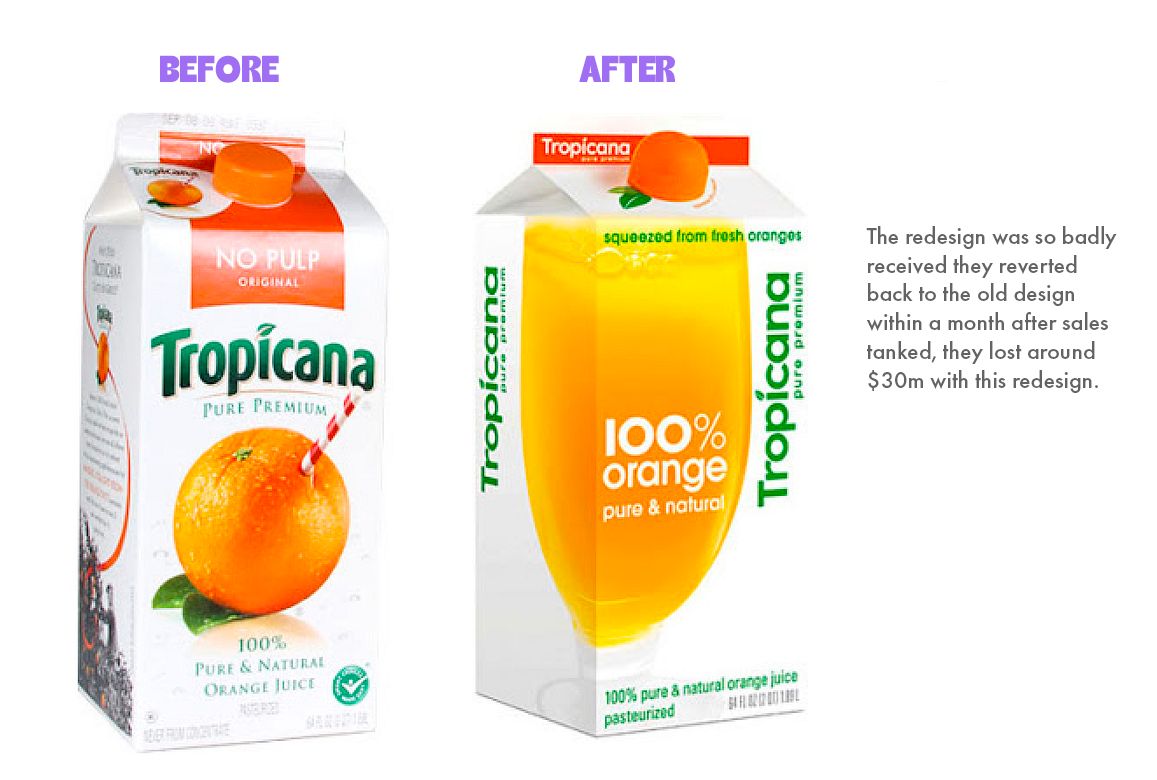
Make it stand out
Tropicana removed all the elements that held strong bonds with their customers, the results were financially devastating. Change for change sake is never a good idea. Which is why rebrands have to be deeply rooted in strategic decision making first.